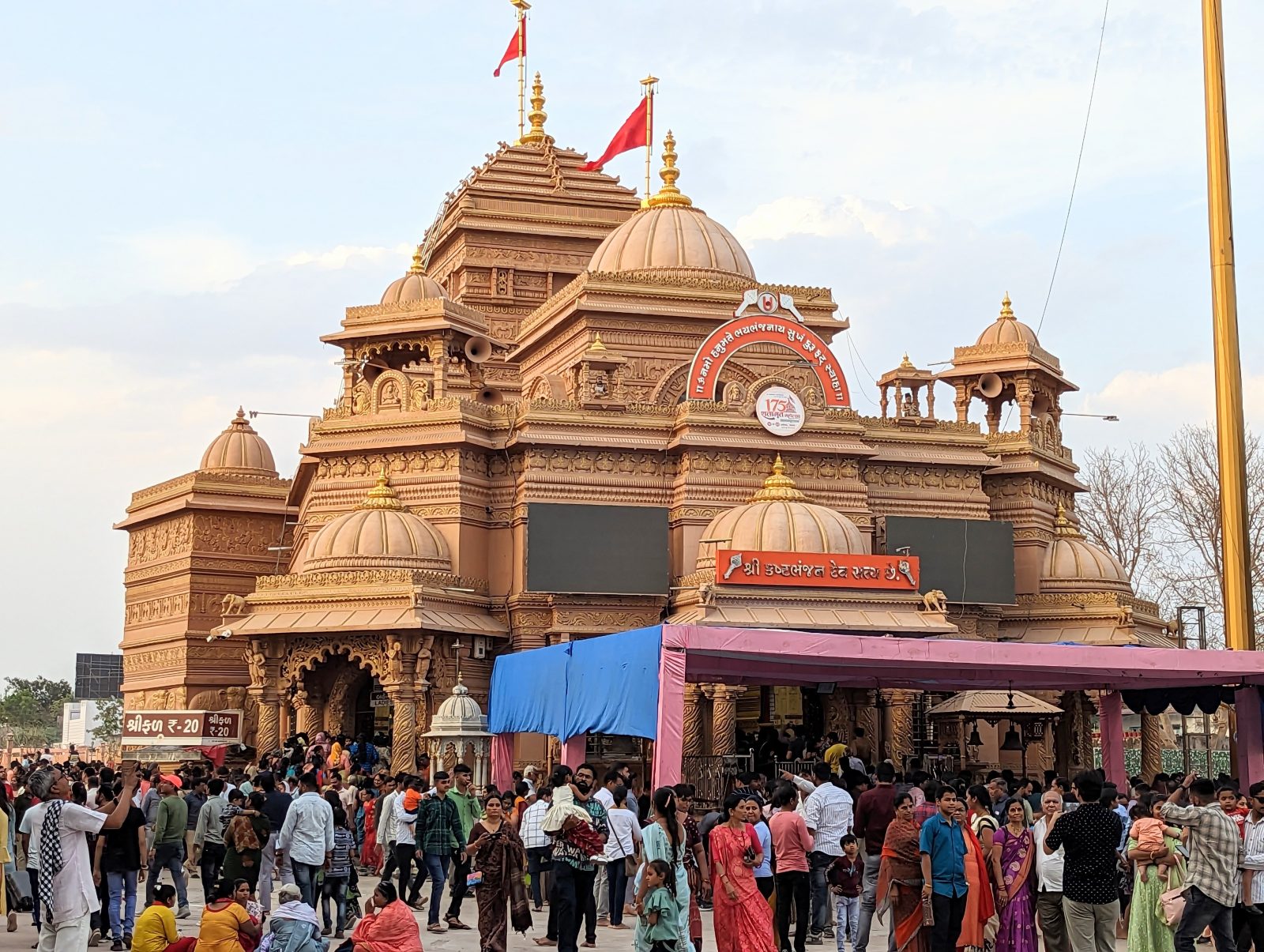
Photo: Rahilarious / Wikimedia Commons, CC BY-SA 4.0
Shree Kashtabhanjan Dev Hanumanji Temple at Sarangpur (Salangpur), Botad district, Gujarat, is one of the most respected Hanuman temples associated with the Swaminarayan Sampraday. Devotees from across Gujarat and other states visit the temple throughout the year for darshan, prayers and blessings.
The temple complex has also become even more recognisable because of the impressive 54-foot "King of Salangpur" Hanuman statue, which has become a major landmark in the area.
If you are planning a visit, especially from Ahmedabad, Vadodara, Gandhinagar or Rajkot, it helps to know the darshan schedule, aarti timings, road conditions, parking arrangements and the best time to arrive.
Temple Darshan Timings
The temple generally remains open for darshan during the following hours:
- Morning Darshan: 5:30 AM to 12:00 PM
- Evening Darshan: 3:30 PM to 9:00 PM
The temple closes for a few hours in the afternoon, so travellers arriving around lunchtime should plan carefully. There are also shorter darshan closures during the day when bhog or thal is offered to the deity:
- Rajbhog Thal: approximately 10:30 AM to 11:15 AM
- Evening Thal: approximately 7:15 PM to 8:15 PM
During these periods, the main deity doors may remain closed temporarily. If you are travelling from another city, reaching the temple earlier in the morning is usually the safest option, particularly on Saturdays and Tuesdays.
Aarti Timings
Mangla Aarti is generally performed at 5:30 AM on Tuesday, Saturday and Purnima.
Shangar Aarti: on Monday, Wednesday, Thursday, Friday and Sunday it's generally held at around 5:45 AM. On Tuesday, Saturday and Purnima, it's normally performed later, at approximately 7:00 AM.
Sandhya Aarti (evening) takes place around sunset, generally between 6:15 PM and 7:00 PM, depending on the season.
Visitors who specifically want to attend an aarti should reach the temple a little earlier because queues and crowd movement usually increase before the main rituals.
Entry Fee and Special Darshan
General entry to Shree Kashtabhanjan Dev Hanumanji Temple is free of cost. Devotees can enter the normal darshan queue without purchasing any ticket.
Special seva or priority darshan arrangements may sometimes be available through the temple counter, with charges generally mentioned in the range of approximately ₹200 to ₹500, depending on the seva or arrangement. Because rules and availability can change, visitors should confirm such facilities directly at the authorised temple counter rather than relying on outside agents.
Dress Code and Temple Rules
Visitors are expected to wear simple and respectful clothing while entering the temple. Traditional Indian attire is common and preferred — men can wear kurta-pajama, dhoti-kurta or regular shirts and trousers, while women generally wear sarees, salwar suits or other modest Indian clothing. There may not be an extremely rigid dress code for every visitor, but revealing or very casual clothing should preferably be avoided.
Photography and mobile phone use are restricted in the inner temple area. Visitors should follow the instructions displayed by the temple authorities and security staff.
Best Time to Visit
Sarangpur receives devotees throughout the week, but Saturday and Tuesday are particularly important days for Hanuman devotees — these are also the busiest days. If you want a calmer visit, consider going on Monday, Wednesday or Thursday.
The best time is usually early morning, between approximately 6:00 AM and 7:30 AM. At this time, the weather is generally more comfortable, parking is easier and the queues are usually shorter than later in the day. If you are travelling with elderly family members or young children, a weekday morning visit will generally be more comfortable.
How to Reach Sarangpur Hanuman Temple
Sarangpur is well connected by road from major cities in Gujarat. For most families and groups, travelling by private car or taxi is the easiest option. Train travel is also possible, with Botad Junction being one of the most convenient nearby railway stations.
| Starting Point | Approx. Distance & Travel Time | Approx. One-Way Cab Fare | Railway Option |
|---|---|---|---|
| Ahmedabad | Around 142–153 km, approximately 2.5–3 hours | Sedan: ₹2,500–₹3,000; SUV: ₹3,000–₹3,500 | Botad Junction is the closest major railway station, roughly 13 km from Sarangpur. |
| Vadodara | Around 188–200 km, approximately 3–3.5 hours | Sedan/SUV: ₹3,500–₹4,500 | Botad Junction is again the most practical nearby railway connection. |
| Gandhinagar | Around 155 km, approximately 3–3.5 hours | ₹2,800–₹3,800 | Travel towards Ahmedabad or Sabarmati first, then onward towards Botad depending on available train connections. |
| Rajkot | Around 115 km, approximately 2–2.5 hours | ₹2,500–₹3,500 | Botad Junction provides convenient railway access from the Rajkot side too. |
Cab prices should be treated as approximate, as fares can change depending on vehicle category, operator, waiting charges and whether the journey is one-way or round trip. For a firm quote, book directly: Ahmedabad to Sarangpur Hanuman cab, Vadodara to Sarangpur Hanuman taxi, Gandhinagar to Sarangpur Hanuman taxi, or Rajkot to Sarangpur Hanuman cab.
Nearest Railway Station
The most practical major railway station for visiting the temple is Botad Junction, approximately 13 km from Sarangpur. From Botad, visitors can hire a taxi, auto-rickshaw or local vehicle for the final journey to the temple. Depending on your route, Jalila Road may also appear as a nearby railway point, but Botad generally offers better onward transport connectivity.
Nearest Airport
The nearest major airport is Sardar Vallabhbhai Patel International Airport, Ahmedabad, approximately 150 km from Sarangpur depending on the road route taken. From Ahmedabad Airport, travellers can hire a direct cab to Sarangpur. For visitors arriving from Mumbai, Delhi, Bengaluru or other major cities, flying into Ahmedabad and then travelling by road is generally the most practical option.
Parking at Sarangpur Temple
One of the advantages of visiting Sarangpur is that the temple complex has large dedicated parking areas. Temple-managed parking is generally well organised, and parking may be available free of cost in designated areas. On regular weekdays, finding parking is usually manageable.
However, on Saturdays, Tuesdays, Purnima, major festivals and public holidays, the parking areas and approach roads can become crowded. If you are travelling with elderly passengers, ask your driver to drop them close to the permitted entrance before taking the vehicle to the main parking area.
Accommodation Near the Temple
Visitors planning an overnight stay have several options around Sarangpur. The temple trust operates large dharamshala and guest-house facilities for devotees — one known facility is Gopalanand Swami Yatrik Bhavan, with other trust-managed dharamshalas and guest facilities also available around the temple complex.
Room prices generally range from approximately ₹500 to ₹1,500 per day, depending on whether you choose an AC or non-AC room and the type of accommodation available. Private options such as Hanumant Guest House are also available close to the temple. During Saturdays, festivals and holiday periods, rooms can fill quickly, so advance confirmation is advisable.
Food and Prasadi Bhojan
The temple operates a Bhojanalaya where devotees can receive prasadi bhojan. Meals are generally served between approximately 11:30 AM and 3:00 PM. The food is provided as prasadi and is generally offered free to visitors. For families planning a full-day visit, this can be a convenient option after completing morning darshan.
Important Things Drivers and Regular Visitors Usually Know
Don't Confuse the Two Major Temple Complexes
This is one of the most useful things to know before visiting Sarangpur. There are two major religious landmarks located close to each other: Shree Kashtabhanjan Dev Hanumanji Mandir and BAPS Shri Swaminarayan Mandir, Sarangpur. Both are famous, large temple complexes, so drivers unfamiliar with your exact destination may sometimes ask which temple you want to visit.
While booking your vehicle, clearly tell the driver: "Kashtabhanjan Hanumanji Mandir, Sarangpur." This will help avoid unnecessary confusion.
Ask for the Correct Drop-Off Point
If possible, ask your driver about the drop-off area near Gate No. 5 or the Hanuman Mandir tower-side parking area, depending on current traffic arrangements. This can reduce unnecessary walking, particularly for elderly visitors. The exact entry and parking arrangement may change on high-rush days, so follow local police and temple traffic instructions when you arrive.
Saturday Traffic Can Get Heavy
Saturday is one of the busiest days at Sarangpur. Large groups, private buses and organised pilgrim tours start arriving from early morning, and the approach roads around Barwala and Sarangpur can therefore become congested. If you are travelling on Saturday, try to reach the Sarangpur side before 7:00 AM — an early arrival usually means easier parking, shorter queues, cooler weather, less traffic and a more comfortable darshan experience.
Suggested Visit Plan from Ahmedabad
For visitors travelling from Ahmedabad, an early-morning day trip works particularly well. A practical schedule could be:
- 4:00–4:30 AM: Leave Ahmedabad
- 6:30–7:00 AM: Reach Sarangpur
- 7:00–9:00 AM: Darshan and temple visit
- 9:00–10:00 AM: Visit the King of Salangpur statue and surrounding temple area
- 10:00–11:30 AM: Relax, explore the complex or participate in temple activities
- 11:30 AM onwards: Prasadi bhojan
- 12:30–1:00 PM: Start return journey
This type of schedule is especially useful on weekends because it allows you to complete the important part of your visit before the heaviest afternoon traffic develops.
Final Travel Tip
For the smoothest experience, visit early in the morning on a weekday. If Saturday or Tuesday is important to you for religious reasons, leave home considerably earlier than usual.
Before starting your journey, it is also sensible to confirm current darshan timings, aarti schedules, accommodation availability and any special-event arrangements directly with the temple, particularly during Purnima, festivals and major religious occasions. A little planning makes a big difference at Sarangpur, especially when travelling with family, senior citizens or a large group.
Frequently Asked Questions
What are the darshan timings at Sarangpur Hanuman Temple?
Morning darshan runs from 5:30 AM to 12:00 PM, and evening darshan from 3:30 PM to 9:00 PM, with short closures around 10:30–11:15 AM and 7:15–8:15 PM for thal/bhog.
What is the aarti timing at Sarangpur Hanuman Temple?
Mangla Aarti is at 5:30 AM on Tuesday, Saturday and Purnima. Shangar Aarti is around 5:45 AM on other days (7:00 AM on Tuesday/Saturday/Purnima). Sandhya Aarti is around 6:15–7:00 PM.
How to reach Sarangpur Hanuman Temple from Ahmedabad?
By road it's around 142–153 km, roughly 2.5–3 hours. Botad Junction (about 13 km from the temple) is the nearest railway station. Book an Ahmedabad to Sarangpur Hanuman cab for a direct door-to-door trip.
How to reach Sarangpur Hanuman Temple from Rajkot?
Rajkot is the closest of the major cities, around 115 km and 2–2.5 hours by road. Book a Rajkot to Sarangpur Hanuman taxi directly.
How to reach Sarangpur Hanuman Temple from Vadodara?
By road it's around 188–200 km, roughly 3–3.5 hours. Book a Vadodara to Sarangpur Hanuman taxi for the trip.
Is there an entry fee at Sarangpur Hanuman Temple?
No, general entry is free. Special seva or priority darshan may be available through the temple counter for approximately ₹200–₹500, confirmed directly with temple authorities.
What is the best time to visit Sarangpur Hanuman Temple?
Early morning (6:00–7:30 AM) on a weekday — Monday, Wednesday or Thursday — is usually calmest. Saturday and Tuesday are the busiest days for Hanuman devotees.